


%204K%20AMS%20SURVEYS%20LOGO.png)


Understanding the Role of Heritage Impact Assessments in Development
Heritage assets are valuable parts of our cultural history, and their preservation is a key aspect of modern development projects. In the UK, Heritage Impact Assessments (HIAs) play a critical role in ensuring that new developments respect the significance of heritage sites while meeting the needs of the present. If you're involved in development, planning, or conservation work, understanding what an HIA entails and why it’s required can be the difference between a smooth planning process and costly delays.
This blog will break down the concept of Heritage Impact Assessments, explaining when they’re required, what they include, and how they influence planning outcomes. We’ll also highlight how they are linked to key guidance from the National Planning Policy Framework (NPPF) and Historic England. To learn more, keep on reading our blog.
What is a Heritage Impact Assessment (HIA)?
A Heritage Impact Assessment (HIA) is a detailed report used to assess the potential impact of proposed development on the significance of heritage assets. Heritage assets can include buildings, structures, landscapes, monuments, and even areas of historic value, such as conservation areas. In simple terms, an HIA helps developers, architects, and planners determine how a new project might affect the historical, cultural, and architectural significance of these assets.
Heritage assets are recognised as valuable components of national and local heritage, and protecting them is a statutory responsibility. The NPPF (National Planning Policy Framework) and Historic England have specific guidelines on how to assess and manage these assets to avoid harm during development. A Heritage Impact Assessment is a key tool in this process.
The primary goal of an HIA is to understand the significance of a heritage asset, assess the potential effects of a proposed development, and identify ways to minimise harm. This process is essential when dealing with protected or significant heritage sites, such as listed buildings, conservation areas, or archaeological sites.
When is a Heritage Impact Assessment Required?
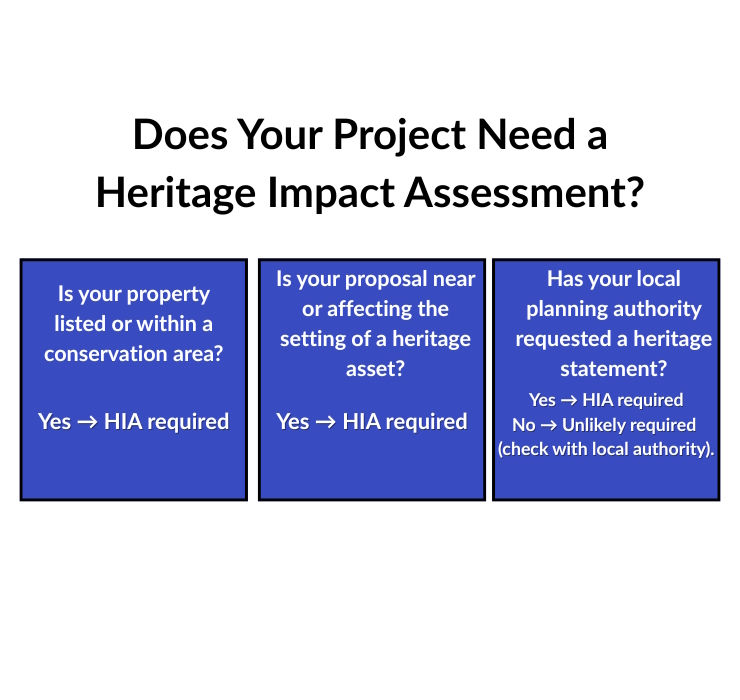
A Heritage Impact Assessment is typically required in the following situations:
Work to a Listed Building
If your development involves work on a listed building, an HIA will be necessary to evaluate the impact of the changes on the building's historic fabric. Listed buildings are protected by law, and any alteration to them must be carefully considered.
Development in a Conservation Area
Conservation areas are areas of special architectural or historic interest, and any new development in these areas requires an HIA to assess the impact on the character and significance of the area.
Development Affecting the Setting of a Heritage Asset
Sometimes, development can affect the setting of a heritage asset without physically altering the asset itself. For example, a new building near a historic site may affect the views or the surrounding environment. An HIA will assess how the development will impact the heritage asset’s setting.
Non-Designated Heritage Assets
In some cases, heritage assets that are not formally listed or designated may still be of local importance. These assets may require an HIA depending on the scope of the development and local planning policies.
Planning Permission Applications
Some local authorities may require a Heritage Impact Assessment or a Heritage Statement as part of the validation process for planning applications. The requirements can vary, but it’s always worth checking with the local planning authority if you’re uncertain whether an HIA is needed.
How Heritage Impact Assessments Influence Planning Outcomes
A well-prepared Heritage Impact Assessment can significantly improve the chances of gaining planning approval for a development project. On the other hand, a poorly prepared HIA can delay the process, lead to refusals, or result in costly redesigns.
There are several ways in which an HIA influences planning decisions:
Providing Evidence of Heritage Significance: One of the key functions of an HIA is to demonstrate a clear understanding of the heritage asset’s significance. This is essential in helping the local planning authority (LPA) make informed decisions about how the development might impact the asset.
Mitigating Harm: If the proposed development could cause harm to the heritage asset, the HIA will outline mitigation measures that can reduce or avoid the damage. This could include redesigning the project, using traditional materials, or preserving key features of the building.
Balancing Harm with Public Benefit: The NPPF requires that the harm to a heritage asset be weighed against the public benefits of the development. An HIA helps to assess this balance and justify why a particular development is in the public interest, even if it results in some harm to the heritage asset.
Guiding Planning Authorities: An HIA is a crucial tool for local planning authorities in assessing the acceptability of a proposed development. It ensures that all heritage-related issues are carefully considered and that any development respects the significance of the heritage asset.
Improving Design Outcomes: A well-conducted HIA can result in better design outcomes. By identifying potential impacts early in the planning process, developers can adjust their designs to respect the heritage of the site, leading to a more harmonious and sensitive development.
AMS Surveys
Heritage Impact Assessments are a critical part of the planning process for developments involving heritage assets. They ensure that the significance of these assets is properly understood and protected, while also allowing for necessary development. By providing a clear assessment of impact and offering mitigation measures, HIAs help developers and planners make informed decisions that respect the past while accommodating the needs of the present.
If you are involved in any form of development on or near heritage assets, it is essential to understand the role of an HIA and engage with heritage surveyors early in the process. By commissioning a thorough HIA, you can avoid delays, minimise risks, and ensure that your project is both sensitive to heritage and successful in the planning process.
Whether you are dealing with a listed building, a conservation area, or any other heritage asset, a Heritage Impact Assessment is the key to safeguarding the historic value of the site while allowing for sensitive development. To make sure your next project respects these principles, contact AMS Surveys for reputable surveys and assessments. Our team will be happy to help you with your heritage property.


